

Real estate ERP handover management should control the rolling delivery plan, two acceptance stages, inspections and snag resolution, customer eligibility and appointments, explicit delivery outcomes, partner evidence, and authorized accounting consequences. It turns handover from a final appointment into a governed operating cycle with traceable decisions.
Real estate ERP handover management should control the rolling delivery plan, two acceptance stages, inspections and snag resolution, customer eligibility and appointments, explicit delivery outcomes, partner evidence, and authorized accounting consequences. It turns handover from a final appointment into a governed operating cycle with traceable decisions.
A property developer cannot manage that cycle reliably through a yearly spreadsheet, separate snag lists, phone messages, and one ambiguous delivered field. The handover record must remain connected to the customer, unit, contract, payment position, project readiness, responsible parties, communications, approvals, and evidence. Archer’s Real Estate ERP model for property developers places these relationships inside the wider commercial, financial, Customer Experience, and operational lifecycle.
What must real estate ERP handover management control?
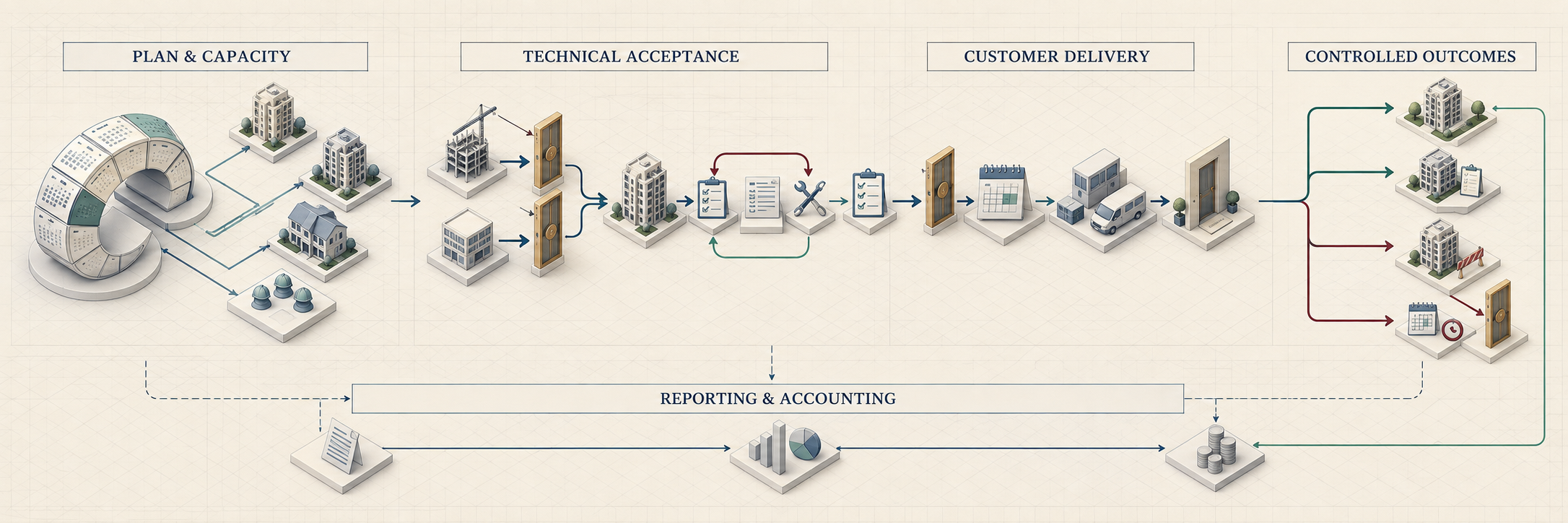
A complete handover design should make eight controls visible and testable:
- Plan and capacity: forecast expected handovers by project and period, then update the plan as readiness and exceptions change.
- Technical acceptance: control the transfer from contractor or consultant to the real estate company before a unit enters customer delivery.
- Inspection and snagging: record findings, responsibility, correction, evidence, reinspection, and acceptance history.
- Partner and team evidence: make recurring problems and relevant handover history visible from the handover record and applicable partner profiles.
- Customer eligibility: verify the configured technical, contractual, financial, document, and approval conditions for delivery.
- Communication and appointments: record contact attempts, responses, dates, attendance, required onsite capacity, and next actions.
- Outcome states: distinguish complete delivery, accepted open items, blocked delivery, no-show, and approved mandatory-delivery treatment.
- Downstream consequences: allow only an authorized state and sufficient evidence to initiate the organization’s approved accounting and cost-allocation processes.
The broad real estate ERP workflow from lead capture to handover explains how customer, unit, contract, payment, service, and approval context reaches this point. This guide begins with handover planning and examines the delivery controls in depth.
Why should the handover plan remain rolling throughout the year?
A yearly handover plan is useful only while it reflects current operational reality. Construction progress, inspections, corrections, documentation, customer eligibility, and appointment outcomes can move expected dates. The ERP should therefore distinguish three different things: an early forecast, a readiness commitment supported by accountable teams, and a confirmed customer appointment.
That separation gives managers a more reliable view of expected workload. They can see how many units may reach technical acceptance, how many require reinspection, which customers may become eligible, and how much onsite capacity is needed by project and period. When a readiness date changes, the effect should be visible to the handover team without silently rewriting the history used to understand the delay.
Planning also belongs inside implementation design. Archer’s Odoo implementation service connects process analysis, configuration, data, roles, testing, training, go-live, and support so that the operating rules behind the plan are defined—not merely the screen used to display it.
Planning principle: A forecast estimates future volume. Readiness confirms that agreed technical conditions have been met. An appointment commits people and a customer to a delivery event. Treating all three as one date hides risk and creates avoidable rework.
Why are there two separate handover stages?
The first stage transfers responsibility from the contractor or consultant side to the real estate company. It is a technical and operational acceptance process: the unit is inspected against the applicable scope, defects are recorded, accountable parties are identified, corrections are followed, and authorized representatives decide whether the unit is accepted, conditionally accepted, or blocked.
The second stage transfers the unit from the real estate company to the customer. It adds different questions: Is the correct customer and contract in scope? Are the configured financial and document conditions met? Has the customer been contacted? Is the onsite team available? Which acknowledgements, keys, documents, readings, or open items must be recorded under the developer’s approved process?
A unit should not move to customer delivery merely because a construction activity appears complete. Each stage needs its own owners, criteria, approvals, documents, dates, and evidence, while remaining linked to the same governed unit and project structure.
How should inspections, snagging, correction, and reinspection work?
A snag list is not a loose attachment to the handover record. Each finding should retain enough structure to explain what was observed, where it was found, who is responsible, whether it blocks delivery, the target action and date, the completion evidence, the reinspection result, and the final disposition. The exact severity model depends on the developer’s rules; the important control is that a new status does not erase the earlier finding or decision.
This history has value beyond a single unit. Repeated findings can reveal common problems by project, location, work type, contractor, consultant, project manager, or another configured handover partner type. Archer has implemented reports that can be accessed from the handover record and from the applicable partner profile. Those reports create evidence for review, but they should not be presented as a universal score or ranking formula unless the organization has approved one.
How should customer eligibility, communication, and onsite scheduling connect?
Once technical readiness is confirmed, the system should evaluate the organization’s configured customer-delivery conditions. These may include the active contract, required installments or other financial clearance, approved documents, unit status, inspection result, unresolved items, and named approvals. The rules can vary by company, project, contract, or jurisdiction; they should not be hidden inside one employee’s spreadsheet.
Financial eligibility must use the current governed payment position. The guide to real estate ERP installment management explains how approved schedules, NPV-driven changes, collections, cheques, allocations, discounts, penalties, accounting, and customer statements remain connected. Handover should consume the approved result rather than reconstructing it manually.
The customer journey then needs traceable communication. Calls, messages, responses, appointment proposals, confirmations, required attendees, and no-shows should remain part of the record. Confirmed appointments should feed the onsite plan so managers can allocate the right people and avoid scheduling more deliveries than a location can support.
Which delivery outcomes must remain distinct?
A single checkbox cannot explain whether the unit was accepted cleanly, accepted with open obligations, blocked, missed by the customer, or treated under an approved mandatory-delivery rule. The following outcome model preserves the operational difference:
| Outcome | Operational treatment | Evidence to preserve | Downstream control |
|---|---|---|---|
| Delivered without snags | Complete the approved customer handover. | Inspection, eligibility, appointment, delivery, and acknowledgement evidence. | Apply the approved delivered-state workflow. |
| Delivered with accepted snags | Deliver while retaining agreed open items. | Accepted items, owners, target dates, status, and customer acknowledgement. | Keep obligations visible after delivery. |
| Blocked pending correction | Do not complete customer delivery. | Blocking snag, responsibility, target, correction, and reinspection. | Prevent premature operational or accounting treatment. |
| Customer no-show | Record the failed appointment. | Contact and appointment history, attendance result, and next action. | Reschedule under the configured policy. |
| Configured mandatory delivery | Apply only after approved conditions are met. | Rule version, eligibility, notices, appointments, no-shows, and approvals. | Apply the approved contractual and accounting treatment. |
How can a configured mandatory-delivery workflow operate?
Mandatory delivery is not a universal legal rule, and the following sequence is not a statement of any client’s policy. It is a hypothetical example of how an approved rule can be made testable:
- Check the configured eligibility conditions, including whether all required installments have been paid.
- Record the first customer no-show and the evidence of the appointment and required notice.
- Schedule another appointment within the configured period—for example, fewer than 15 days.
- Record the second no-show if it occurs, preserving the contact and attendance history.
- Apply the configured mandatory-delivery treatment only when every contractual, legal, operational, approval, and accounting condition has been satisfied.
The real rule may use a different period, notice method, number of attempts, approval route, or financial treatment. Those conditions should come from the developer’s approved contracts, policies, professional advisers, and applicable jurisdiction. ERP configuration should enforce the approved rule and version; it should not invent the rule.
How should delivery status govern accounting events?
Delivery evidence can be an important input to accounting, but an informal status change must not create unsupported revenue, cost of goods sold, or cost-allocation consequences. The control design should identify the authorized delivery state, required documents and approvals, applicable contract, accounting policy, legal entity, project and unit, effective date, journal logic, and exception route.
IFRS 15 frames revenue recognition around satisfying a performance obligation when the customer obtains control of the promised good or service. Physical handover may provide evidence, but it is not a universal substitute for evaluating the contract, control, performance obligations, jurisdiction, and approved accounting policy. The ERP should preserve the evidence and execute the organization’s approved treatment; it should not turn one operational checkbox into an accounting conclusion.
That distinction also protects cost allocation. A unit, project, analytic structure, contract, delivery outcome, and approved accounting event should remain traceable to each other so Finance can explain why and when the consequence occurred.
What do MBG, New Jersey Developments, and Centrada demonstrate?
These Archer Solutions projects show different aspects of connected handover control. They are bounded examples from specific scopes, not promises that every implementation uses the same workflow, timing, or accounting treatment.
MBG Developments: complex handover inside a multi-project environment
MBG Developments operates a 120-user Odoo 19 environment across multiple projects. Its confirmed scope connects real estate sales, NPV payment plans, broker commissions, Finance, Customer Experience, Handover, Human Resources, and relevant integrations. The lesson for handover is architectural: delivery controls must use the same governed customer, unit, contract, financial, service, and project context rather than creating a separate final-stage record.
New Jersey Developments: current delivery with substantial unit continuity
New Jersey Developments has six projects and 1,710 units in the approved public case, and its current system includes Handover while the company is delivering units. NJD’s exceptional migration and recovery history is not a normal handover baseline. Its relevant lesson here is continuity: delivery activity depends on dependable relationships among companies, projects, units, customers, contracts, installments, payments, cheques, accounting, service, and handover.
Centrada Developments: Customer Experience and handover without overstating scope
Centrada Developments uses a connected 130-user Odoo 18 environment covering real estate and NPV operations, CRM and sales, brokers and commissions, accounting and Finance, Helpdesk and Customer Experience, Handover, and Human Resources. The company has delivered units. Construction remained outside the confirmed ERP scope, demonstrating that strong customer handover control does not require falsely claiming that every construction activity is inside the same implementation.
How should buyers test a real estate ERP handover design?
Ask the proposed implementation team to demonstrate one unit from rolling forecast through an accepted outcome, then introduce a blocking snag and a customer no-show. The design should answer these questions:
- How are expected handovers forecast by project and period, and who may revise the plan?
- How does the system distinguish forecast, technical readiness, customer eligibility, and confirmed appointment?
- What evidence moves a unit from contractor or consultant acceptance into company control?
- How are snag, location, responsibility, evidence, correction, and reinspection preserved?
- Can recurring findings be reviewed from the handover and applicable partner records without inventing unsupported scores?
- Which contractual, financial, technical, document, and approval conditions determine customer eligibility?
- How are calls, responses, notices, appointments, attendance, onsite capacity, and rescheduling recorded?
- Can the system distinguish clean delivery, accepted open items, blocked delivery, no-show, and configured mandatory delivery?
- Who owns each exception, which action is due, and what prevents an unresolved item from disappearing?
- How are rule versions and approvals retained when a policy changes?
- Which authorized state can initiate accounting treatment, and what evidence must Finance be able to trace?
- Can users explain the complete history without reconciling separate spreadsheets and message threads?
This operational test should sit inside the wider provider assessment. Archer’s 10-point real estate ERP implementation partner evaluation matrix helps buying teams test industry understanding, architecture, delivery governance, evidence, support, scalability, and team fit—not only a handover demonstration.
For Egyptian and regional developers, installment-led sales, post-dated cheques, multi-company structures, broker relationships, customer statements, formal notices, and project-specific delivery policies can make handover especially dependent on connected data. Geography changes the configured rules, documents, and responsibilities; it should not create competing versions of the customer, unit, payment, snag, or delivery truth.
A dependable handover process is not the one with the shortest checklist. It is the one that can plan capacity, prove readiness, preserve exceptions, organize the customer appointment, explain the outcome, and control downstream consequences. If your organization is defining or testing that process, discuss your real estate ERP project with Archer Solutions.