

There is no responsible universal real estate ERP implementation timeline. A focused launch using proven capabilities can move quickly, while a multi-company transformation with difficult history, integrations, and broad acceptance takes longer. The credible timeline is the one that identifies dependencies, separates elapsed time from effort, and makes business decisions, data, testing, and rollout readiness visible.
There is no responsible universal real estate ERP implementation timeline. A focused launch using proven capabilities can move quickly, while a multi-company transformation with difficult history, integrations, and broad acceptance takes longer. The credible timeline is the one that identifies dependencies, separates elapsed time from effort, and makes business decisions, data, testing, and rollout readiness visible.
Why every real estate ERP implementation timeline is different
“How long will it take?” sounds like a software question, but most schedule risk sits in the operating model around the software.
A real estate implementation may need to connect unit availability, reservations, contracts, amendments, installment schedules, cheques, collections, accounting, service activity, and handover. It may also include optional construction, procurement, inventory, project cost, HR, or multi-company controls. Each included area adds decisions, data, access, scenarios, and business owners.
The Real Estate ERP operating model should therefore be defined before a duration is presented. The first schedule question is not “How fast can the software be installed?” It is “What must be accepted as operational at the first release?”
Proven features shorten development—but they do not remove implementation work
An experienced implementation partner should not rebuild common real estate capabilities for every client. Delivered features, reusable controls, tested lifecycle relationships, and accumulated team experience reduce discovery uncertainty and the volume of new development.
Archer’s current real-estate delivery model now supports four system deliveries per quarter. Because the underlying feature set has been enriched through repeated implementations, remaining client-specific development is currently contained within a maximum two-week window. This is evidence of present delivery maturity; it is not a promise that an entire implementation, migration, UAT cycle, and organizational go-live will finish in two weeks.
This distinction is consistent with Odoo’s official implementation methodology, which treats implementation as a managed delivery discipline rather than a software-installation event. Configuration and development can move quickly while data preparation, decisions, validation, training, and adoption still determine the elapsed schedule.
The distinction matters:
- Feature readiness asks how much of the required operating model already exists and has been used before.
- Client-specific change covers the remaining approved gap that genuinely needs tailoring.
- Implementation elapsed time also includes decisions, data preparation, integration access, configuration, security, validation, training, cutover, and acceptance.
A provider may complete its own configuration quickly and still wait for approved opening balances, contract rules, interface credentials, or business sign-off. Conversely, a prepared buyer and a mature delivery team can run workstreams in parallel without sacrificing control.
This is why partner choice affects time. The 10-point real estate ERP implementation partner evaluation tests industry understanding, proven capability, architecture, team structure, governance, support, and delivery evidence rather than relying on a short proposal duration.
The same scope, data, integration, governance, and acceptance dependencies also affect effort and quotation. The companion guide to real estate ERP implementation cost explains how buyers can compare those drivers without reducing the decision to a package price.
The schedule is a dependency network, not a single sequence
A credible real estate ERP implementation timeline usually includes the following workstreams:
| Workstream | Can overlap with | Must be ready before |
|---|---|---|
| Operating analysis and scope | Early data profiling and environment preparation | Final configuration and gap acceptance |
| Configuration and approved tailoring | Data cleansing, role design, report definition | End-to-end UAT |
| Data preparation and trial migration | Configuration and integration work | Cutover and financial acceptance |
| Integrations | Configuration, data work, and scenario design | Integrated UAT and go-live |
| Roles, approvals, and security | Configuration and scenario preparation | UAT and production access |
| UAT and reconciliation | Training preparation and cutover rehearsal | Formal go-live approval |
| Training and adoption | Final UAT and cutover preparation | Daily operational use |
| Cutover and stabilization | Limited support preparation | Transition to normal operations |
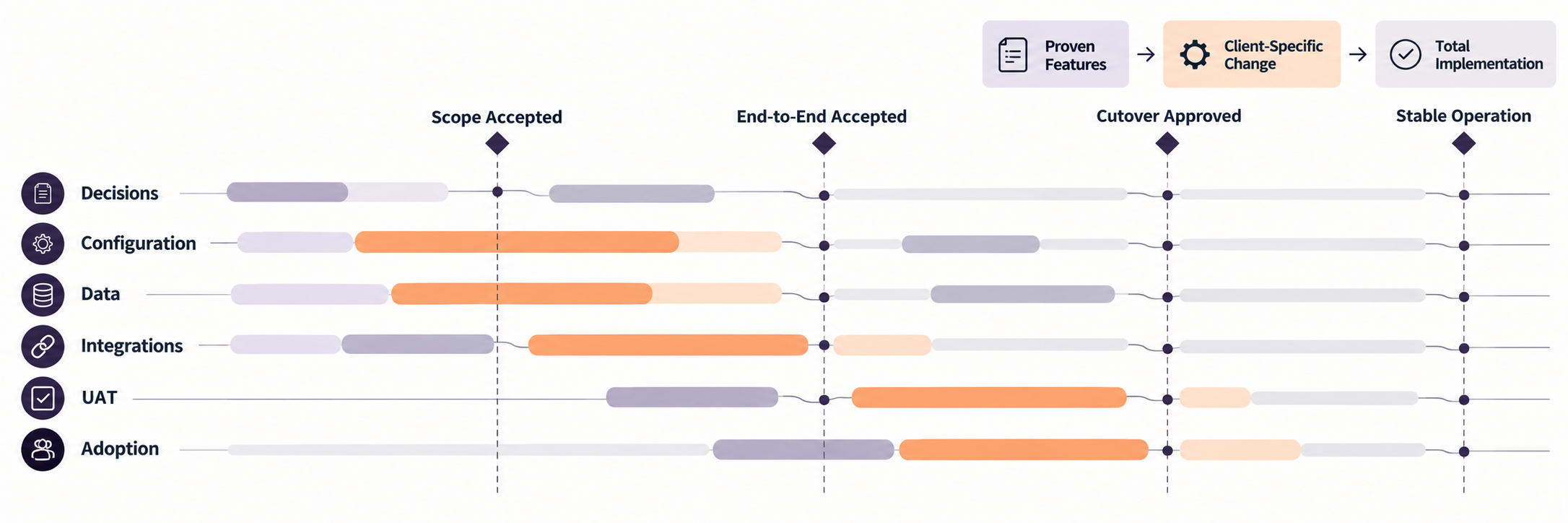
Running these workstreams in parallel can shorten elapsed time. It only works when dependencies and owners are explicit. Parallel work without controlled decisions produces rework rather than speed.
Decisions are a schedule dependency
The buyer must make timely decisions about contract policy, payment rules, exception approval, accounting treatment, visibility, reports, and acceptance. A decision log should name the owner, due date, options, and downstream effect. Unresolved policy cannot be solved by adding developers.
Data is a schedule dependency
Opening records and historical migration require different effort. If the business needs years of contracts, installments, collections, and accounting continuity, the source must be profiled early. Trial migrations and reconciliations should happen before final cutover, not after configuration is declared complete.
UAT is a business activity
User acceptance testing is not a demonstration. Business users must perform realistic scenarios across departments, including exceptions, approvals, access restrictions, reconciliations, statements, and reports. A schedule that allocates no time for business correction and retesting is simply moving risk into go-live.
Parallel work is credible only when each stream has a clear owner and usable inputs. Integration preparation can begin once interfaces and responsibilities are agreed. UAT scenarios can be written while configuration continues, but execution still needs stable paths and reconciled data. Training materials should follow accepted workflows. A schedule that overlaps every activity from day one often hides dependencies instead of removing them.
What the delivery evidence says—and what it does not say
A real estate ERP implementation timeline should be interpreted through the release definition, scope, data condition, and operating dependencies behind it. The examples below show why one duration cannot be copied into another project as a promise.
Madkour Developments launched an expression-of-interest capability in ten days, then implemented the full real-estate scope and later expanded into additional functions. The ten-day result is evidence of phased delivery, not a claim that the full ERP implementation took ten days.
Modon Developments followed a 12-week program with six two-week phases covering requirements, approved gaps, testing, six years of data, department-based training, and controlled launch across five companies and eight projects.
Reach Real Estate required a January-to-August program for 175 users across eight country operations, strict SOPs, configurable rules, country-specific controls, and integration-led transfer of approximately 200,000 leads plus wider operational history.
El Nasr Housing & Development used a one-year core rollout for a broad on-premise environment and the reconstruction of approximately 40 years of history, followed by two years of controlled expansion.
The cases demonstrate different release definitions, scope, data conditions, and dependencies. They should not be averaged into a generic promise.
How to test whether a proposed timeline is credible
Ask the implementation team to show:
- The exact first-release scope and the definition of “go-live.”
- Which required capabilities already exist and have been delivered before.
- Which client-specific changes remain and how their acceptance is defined.
- The workstreams that run in parallel and the dependencies between them.
- The buyer decisions and source data required by date.
- At least one trial migration and reconciliation cycle where historical data is in scope.
- Role, integration, exception, and end-to-end UAT scenarios.
- Training responsibilities and participant availability.
- Cutover, rollback, stabilization, and issue-ownership rules.
- The boundary between initial go-live support and later support or expansion.
Warning signs include a duration stated before scope analysis, a plan that treats UAT as one meeting, migration scheduled only at the end, customization with no acceptance criteria, and a provider schedule that assigns no responsibilities to the buyer.
The shortest reliable schedule is the one with the fewest unresolved assumptions
The shortest reliable real estate ERP implementation timeline benefits from implementation experience and a mature feature base, which can reduce development time significantly. They cannot substitute for approved policies, usable data, integration access, business testing, and organizational readiness.
Use Archer’s ERP implementation approach to examine the delivery phases. If you need a schedule based on your actual scope and readiness, discuss your ERP project with the required lifecycle, data, decisions, integrations, and acceptance owners identified.