

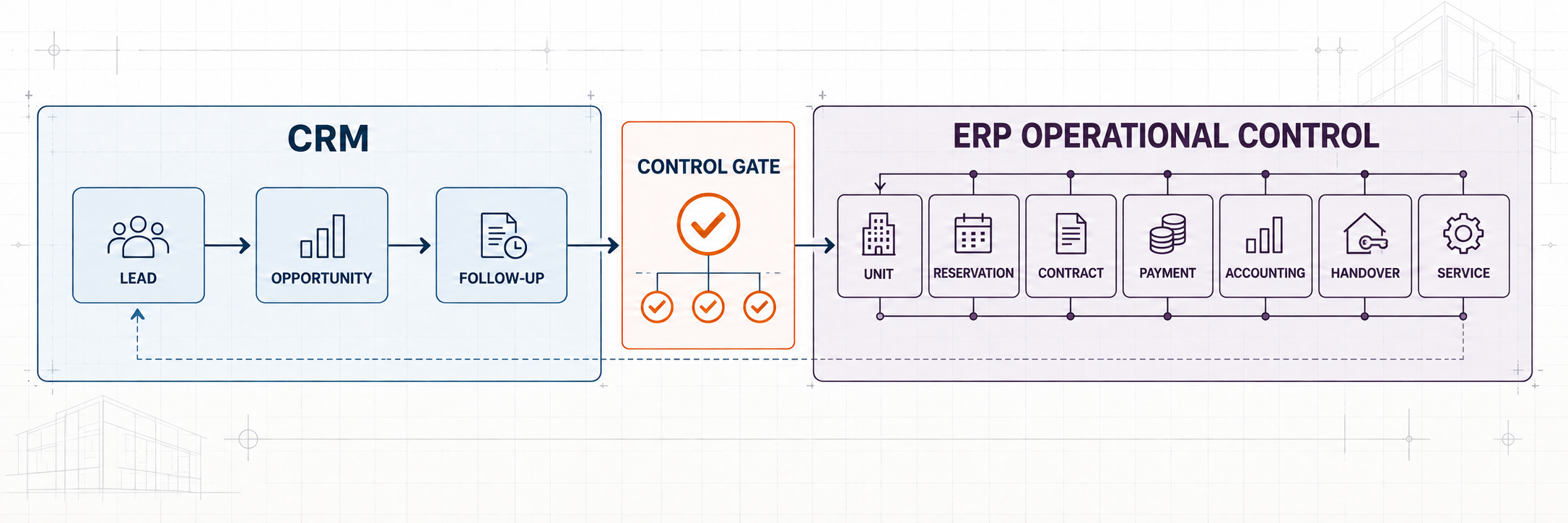
CRM should manage lead capture, qualification, communication, and sales follow-up. ERP control should begin when an approved decision creates an operational or financial commitment: holding a unit, approving commercial terms, issuing a reservation or contract, creating a payment obligation, recording accounting, managing handover, or servicing the customer. The two layers should remain connected, with clear ownership for every record.
Real estate CRM vs ERP is not a choice between maintaining customer relationships and running operations. CRM is strongest while demand is uncertain: capturing leads, qualifying opportunities, recording communication, planning follow-up, and forecasting the pipeline. ERP becomes authoritative when an approved decision affects a unit, a commercial commitment, a contract, a payment obligation, accounting, handover, or service.
Direct answer: CRM should manage lead capture, qualification, communication, and sales follow-up. ERP control should begin when an approved decision creates an operational or financial commitment: holding a unit, approving commercial terms, issuing a reservation or contract, creating a payment obligation, recording accounting, managing handover, or servicing the customer. The two layers should remain connected, with clear ownership for every record.
Real estate CRM vs ERP: what is the operating difference?
CRM manages the relationship before and around a buying decision. It should help a commercial team understand who expressed interest, which project or property type matters, how the opportunity developed, what communication occurred, who owns the next activity, and whether the opportunity remains active. The record is expected to change as the sales conversation develops.
ERP controls commitments that other departments must be able to trust. When Sales holds a specific unit, submits a discount for approval, creates a reservation, or accepts a payment arrangement, the decision affects more than the opportunity pipeline. It can change availability, contractual rights, receivables, commissions, accounting, customer statements, handover eligibility, and future service responsibilities.
This is a responsibility distinction, not necessarily a software-vendor split. In a connected platform such as Odoo, CRM is a native application within the wider ERP environment. Odoo’s official documentation describes a lead as a qualification step before an opportunity and allows the opportunity to be linked to a new or existing customer. It also shows that creating a quotation from CRM depends on the connected Sales application. The useful architectural question is therefore not “Which system contains CRM?” but “Which record becomes authoritative when interest turns into an operational obligation?”
Archer Solutions’ broader Real Estate ERP model for property developers covers the connected lifecycle from units and reservations through contracts, installments, customer service, and handover. This article focuses only on the boundary at the beginning of that lifecycle.
Where should the CRM-to-ERP control gate sit?
The boundary should sit at the first approved event that changes a controlled business record. It is usually too early to create operational records for every unqualified enquiry, but too late to wait until accounting receives a payment or a signed contract reaches another department. A unit may already have been held, commercial terms approved, or a reservation accepted.
The exact trigger varies by developer. Some organizations create a provisional customer and unit hold after an approved reservation request. Others require payment evidence or a signed form before the commitment becomes active. The design must name the trigger, approver, record owner, expiry or reversal rule, and evidence that allows the next department to proceed.
| Decision or record | CRM responsibility | ERP operational control |
|---|---|---|
| Lead and interest | Capture source, contact, preferences, qualification, activities, and communications. | No operational commitment is required for an unqualified lead. |
| Opportunity | Manage sales stage, probability, owner, next action, interests, and proposal communication. | Provide controlled availability, price rules, and approval conditions without creating an unsupported commitment. |
| Customer identity | Collect and qualify contact information; detect possible duplicates. | Establish the governed customer or party identity used by contracts, payments, accounting, statements, handover, and service. |
| Unit and availability | Record preferences and present approved available choices. | Own project, phase, building, unit, status, hold, reservation, release, and conflict controls. |
| Commercial terms | Develop the proposal and record negotiation context. | Apply approved price, discount, payment-plan, authority, version, and exception rules. |
| Reservation and contract | Retain relationship context and follow-up. | Own approved reservation, contractual parties, unit, terms, amendments, status, and document history. |
| Payment and accounting | Show authorized commercial context where useful. | Own obligations, collections, allocations, reconciliation, accounting treatment, balances, and statements. |
| Handover and service | Continue coordinated communication with the customer. | Control eligibility, readiness, inspections, documents, approvals, key delivery, requests, ownership, and service history. |
The handoff does not mean CRM disappears. Sales and Customer Experience may continue communicating with the customer for years. It means that communication must refer to governed operational records instead of creating a second version of availability, contract status, payment position, handover readiness, or service history.
Seven records ERP operational control must protect
Once the control gate is crossed, seven connected records determine whether the organization can continue operating without departmental reconciliation.
- Unit: Project structure, ownership or inventory context, availability, holds, reservations, releases, and status history must be authoritative. Two salespeople cannot rely on separate availability lists.
- Reservation: The system should preserve the customer, unit, approved terms, required documents, payment evidence, expiry, cancellation, conversion, and approving authority.
- Contract: Parties, unit, price, schedule, amendments, transfers, cancellations, and active status form a long-lived operational and legal relationship—not a note attached to a won opportunity.
- Payment: Obligations, instruments, receipts, allocations, changes, outstanding amounts, and customer statements must remain connected to the approved contract and unit.
- Accounting: Companies, accounts, journal entries, reconciliations, analytic dimensions, commissions, and reporting must follow the approved operating and accounting design.
- Handover: Eligibility may depend on contract status, payment clearance, unit readiness, inspection, documentation, approvals, and key delivery. A calendar activity alone cannot control this milestone.
- Service: Customer requests, responsible teams, status, history, documents, and resolutions should retain the customer, contract, and unit context after the original sale.
These are not seven isolated modules. A change in one may affect several others. Releasing a reservation changes availability. Amending a contract may change payment obligations. Payment clearance can affect handover eligibility. A service request may need the exact unit, contract, and prior handover record.
The payment side of this boundary requires its own control depth. Archer’s guide to real estate ERP installment management explains how approved plans, collections, allocations, accounting treatment, and customer statements must remain connected after the commercial handoff.
How should the connected architecture work?
A sound architecture allows CRM and ERP responsibilities to be different without creating disconnected data. The design should identify the owner of each record, the event that creates or updates it, the approvals required, and what information returns to the engagement layer.
Use one governed identity and explicit record ownership
A lead may arrive without complete or verified information. The system should support qualification and duplicate detection before that person becomes the governed customer identity used by contracts and accounting. The opportunity can retain campaign, source, communication, and sales-stage context, while the operational record supplies current unit, contract, payment, handover, and service status.
Make the approval event visible
The transition should not depend on a salesperson copying data into another screen and sending a message to Finance. A controlled action should validate mandatory data, authority, availability, commercial terms, and supporting documents; create or update the correct operational records; preserve the originating opportunity; and return an unambiguous status to CRM.
Choose the integration pattern deliberately
A native connected suite can share customer, activity, sales, finance, and service foundations. An external marketing or specialist CRM can also remain in place when a governed API transfers qualified data and returns the operational status required by the commercial team. A hybrid design may capture enquiries through websites, social channels, messaging, or campaigns, qualify them in CRM, and create ERP commitments only after the approved gate.
Odoo’s official documentation shows the normal progression from lead qualification to an opportunity and linked customer, then from an opportunity to a quotation through the connected Sales application. Archer’s Odoo ERP platform overview explains the wider connected-app foundation. Real estate implementation design adds the project, unit, reservation, contract, payment, commission, handover, and service controls that determine when the commercial conversation becomes an operational obligation.
Let geography change the rules, not the ownership principle
An Egyptian developer with several legal companies and a regional group operating across countries may require different accounting, security, visibility, commission, document, or service rules. Those differences belong in the governed operational design. They should not create competing customer, unit, contract, or payment truths in each country’s spreadsheet or sales pipeline.
What Modon and Reach demonstrate
The following Archer Solutions projects demonstrate two different ways to connect engagement with operational control. They are specific implementation examples, not universal performance promises.
Modon Developments: native lead capture connected to group operations
Archer implemented Odoo 18 for Modon Developments, supporting 200 users across five companies and eight projects. Meta and WhatsApp integrations route leads into a structured commercial process. The same environment connects CRM and sales with real estate and NPV operations, broker commissions, accounting, Helpdesk, and Customer Experience.
This example shows why lead integration is valuable only when the downstream architecture is controlled. Customer communication can begin in external channels, but approved transactions must operate within the same governed company, project, commercial, accounting, and service structure. Modon’s six years of migrated history also preserves the context required for customer account reviews across long payment cycles.
Reach Real Estate: API-connected acquisition and multinational control
For Reach Real Estate, Archer implemented Odoo 18 on Odoo.sh for 175 users across eight country operations. Integration with Reach’s marketing platform transferred approximately 200,000 leads, while units, contracts, payments, and other operational history moved into the governed environment. The platform went live in August 2026.
The resulting architecture connects CRM and sales with owned and brokered units, contracts, payments, country-specific accounting, tiered commissions, refunds, communications, and residency-service workflows. Reach demonstrates that a marketing or acquisition platform does not have to become the operational system of record. A controlled integration can preserve lead scale and channel specialization while ERP governs country rules, permissions, commitments, and financial consequences.
Architecture principle: Keep engagement flexible while intent is uncertain. Make commitments governed when they affect other departments, and return enough operational status to CRM for the customer relationship to continue without a second version of the truth.
How should buyers validate the CRM-to-ERP boundary?
System architecture is one part of the broader provider decision. Archer’s 10-point real estate ERP implementation partner evaluation matrix places it alongside industry understanding, delivery governance, proof, scalability, support, and team alignment. For this boundary specifically, a product demonstration should follow one realistic opportunity through the control gate and prove what each team can see, change, approve, and trust. Buyers should ask the implementation team to demonstrate the following:
- Lead qualification: How are sources, duplicates, ownership, activities, and communication handled before a governed customer exists?
- Availability: Which system owns projects and units, and how does CRM receive current availability without maintaining a parallel list?
- Commercial approval: Who can propose or approve price, discount, payment-plan, and exception terms, and where is the approved version preserved?
- Reservation trigger: What exact event creates the hold or reservation, what evidence is required, and how are expiry, cancellation, and release controlled?
- Customer identity: How does the architecture prevent separate lead, customer, contracting-party, and accounting identities from drifting apart?
- Contract and payment continuity: Can the team trace the opportunity through reservation, contract, obligations, collections, accounting, and customer statement?
- Commission control: Is eligibility based on an approved transaction and policy rather than a manually marked CRM stage?
- Handover: Does the system check contract, payment, readiness, inspection, document, and approval conditions before delivery?
- Service continuity: Can Customer Experience work from the same customer, contract, unit, and handover context without rebuilding it?
- Integration recovery: What happens when a channel, API, or synchronization fails, and how are duplicates, retries, ownership, and audit evidence controlled?
Warning signs include CRM carrying its own availability list, reservations created without an expiry or release rule, approved terms copied manually into contracts, payment status returned as free text, commissions triggered only by “Won,” handover managed as an isolated calendar task, and customer service working without contract or unit context.
The right design does not replace CRM with ERP or push every enquiry into accounting. It gives engagement and operational control different responsibilities inside one connected architecture. CRM continues to support the relationship; ERP protects the commitments that Sales, Finance, Accounting, Customer Experience, and Handover must all be able to explain.
If your organization is deciding where lead management should hand over to unit, contract, payment, accounting, handover, and service control, discuss your real estate CRM and ERP architecture with Archer Solutions.