

A real estate ERP controls long-term installments when every obligation and collection remains traceable to the customer, unit, contract, approved plan version, payment instrument, allocation, accounting entry, and customer statement. Rescheduling, penalties, discounts, cheque changes, and corrections must update the right layers without erasing the history that explains the account.
Real estate ERP installment management is not simply the creation of future due dates. A dependable system must keep the approved commercial plan, collections, payment instruments, allocations, accounting treatment, customer statement, and every authorized change connected throughout a contract that may remain active for years.
Direct answer: A real estate ERP controls long-term installments when every obligation and collection remains traceable to the customer, unit, contract, approved plan version, payment instrument, allocation, accounting entry, and customer statement. Rescheduling, penalties, discounts, cheque changes, and corrections must update the right layers without erasing the history that explains the account.
Why a payment schedule is not the same as account control
A schedule can show that a customer owes a particular amount on a particular date. It does not, by itself, explain why that amount exists, how it relates to the approved commercial offer, what changed after signing, which cheque or payment settled it, how the receipt was allocated, or whether the customer statement agrees with accounting.
This distinction matters in installment-led real estate operations in Egypt and similar regional markets. A single unit may remain commercially and financially active for years. During that period, the customer may request a reschedule, pay early, pay late, replace an instrument, buy another unit, transfer an agreement, or raise a service question. Sales, Treasury, Accounting, After Sales, and Customer Experience must still be looking at one explainable account.
Standard ERP foundations are useful but are only the starting point. Odoo’s official documentation explains that payment terms can define due dates, installment plans, and early-payment discounts. A real estate operating model must then connect those accounting capabilities to the longer-lived unit, contract, amendment, collection, and customer-service context described on Archer Solutions’ Real Estate ERP page.
The system must preserve several kinds of truth
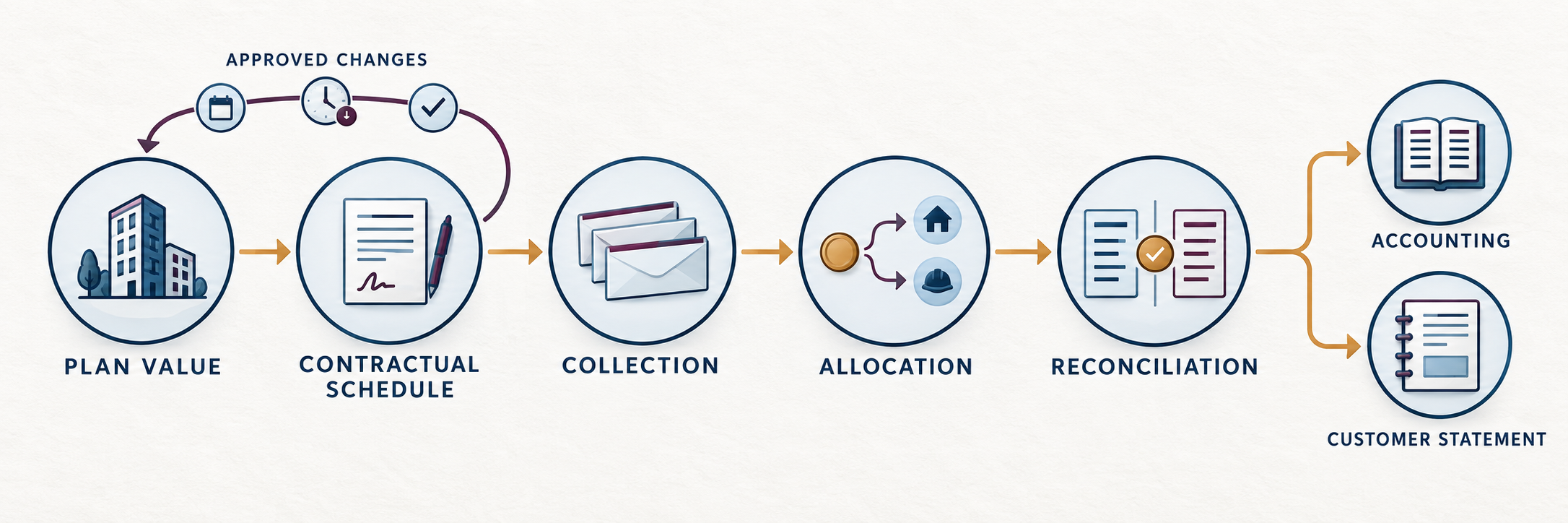
The commercial plan explains the approved price structure and timing. The contractual schedule records the enforceable obligations. Treasury records the payment instruments and collection events. Accounting applies the approved posting and recognition policy. The customer statement presents an understandable account position. These layers should reconcile, but they are not interchangeable.
For example, a changed rate may affect the commercial or net-present-value assessment, the future receivable schedule, an interest component, or another accounting treatment. The correct result depends on approved policy. Collapsing every effect into a generic “revenue” field makes the account harder—not easier—to explain.
Seven controls in real estate ERP installment management
A buying team should test the complete chain rather than review a payment-plan screen in isolation. The following seven controls define whether the system can maintain continuity after the sale.
| Control | What must remain connected | Validation question |
|---|---|---|
| 1. Plan value | Unit, price components, payment pattern, rates, NPV assumptions, approvals, and effective version | Can the system reproduce why this plan was approved? |
| 2. Contractual schedule | Contract, installment type, amount, due date, status, amendment, and remaining obligation | Does the current schedule agree with the active contract and amendments? |
| 3. Approved changes | Rescheduling, early-payment discounts, late-payment treatment, waivers, authority, and before-and-after values | Can users see what changed, who approved it, and its effect? |
| 4. Payment instruments | Cheque or transfer identity, payer, bank, maturity, custody, deposit batch, replacement, rejection, and status history | Can Treasury trace the instrument without relying on a separate spreadsheet? |
| 5. Allocation | Collection amount, customer, contract, unit, installment, split, residual amount, and allocation history | Can every collected amount be traced to the obligations it settled? |
| 6. Reconciliation and accounting | Receipt, bank movement, journal entry, company, account treatment, principal or interest components, and exception | Do operational and accounting records reconcile under the approved policy? |
| 7. Customer statement | Opening position, due and future obligations, receipts, allocations, approved changes, outstanding amounts, and statement date | Can Customer Experience explain the account without rebuilding it manually? |
A weakness in one control propagates. An unapproved schedule change can produce the wrong due position. An unidentified cheque can create an apparent overdue balance. A correct receipt allocated to the wrong unit can distort two customer accounts. A statement generated before reconciliation can cause an unnecessary dispute.
How approved plan changes should work
A payment plan should be managed as a complete commercial structure. The system must retain the active plan, its prior approved version, the reason for change, the calculation basis, the approving authority, and the effect on future obligations. It should not silently overwrite the original schedule or merely redistribute the same nominal total across new dates.
Rescheduling needs an economic rule
Moving money through time changes the economics of an offer. Where the organization’s approved policy uses net present value (NPV), the ERP should evaluate the revised timing and rate assumptions consistently before a reschedule is accepted. The result must be visible to authorized Commercial and Finance reviewers, while the customer-facing contract and schedule use the approved outcome rather than exposing internal calculation detail.
The same governance principle applies to early-payment discounts and late-payment treatment. The system should distinguish an automatic rule from an exceptional waiver, require the right approval, and preserve the before-and-after values. It should also prevent one department from treating a commercial adjustment as if it automatically defined the accounting treatment.
Reports should explain the effect, not just show a new balance
Management needs to see how rescheduling, early payment, late payment, and rate changes alter the commercial plan and the relevant financial results. The report should name its measure precisely—for example, revised commercial or NPV value, receivable timing, principal, interest, or another accounting amount. “Revenue impact” is too ambiguous unless the implementation defines exactly which accounting policy and measure it represents.
Decision rule: A plan change is controlled only when the organization can reproduce the old position, the approved rule, the new position, the accounting consequence, and the customer-facing result.
How collections reach accounting and customer statements
Collections introduce a second chain of evidence. A cheque or transfer is not the same object as the obligation it will settle. One payment can settle one installment, several installments, or defined obligations across more than one contract or unit when policy permits. A grouped bank deposit may also contain instruments from different customers. The ERP must preserve instrument identity and allocation detail even when Treasury processes them together.
For post-dated cheques, useful controls normally include maturity, custody location, deposit batch, payer, bank, replacement, rejection, redeposit, cancellation, and current status. Splitting or grouping an operational batch must not erase the relationship between the physical instrument, the collection event, and the customer obligations. Exceptions need an owner and an auditable resolution.
Odoo’s current documentation distinguishes payments, group payments, batch payments, checks, outstanding amounts, and reconciliation. Real estate implementation design determines how those accounting objects connect to units, contracts, installment schedules, and the additional cheque lifecycle required by the developer.
Accounting and the customer statement answer different questions
Accounting needs the entries, companies, accounts, periods, reconciliations, and treatment required by policy. Customer Experience needs a clear, current explanation of what the customer has paid, what remains due, what is scheduled later, and which approved changes affected the account. A customer statement is therefore not a substitute for the general ledger, and a ledger extract is not automatically an understandable customer statement.
Odoo describes its customer statement as the customer-specific portion of the Partner Ledger and provides a separate follow-up report for due and overdue invoices. That standard customer-statement and follow-up foundation becomes more useful when the real estate implementation also preserves the contract, unit, installment, allocation, cheque, and approved-change context.
What implementation evidence shows
The following Archer Solutions projects demonstrate different parts of the control model. They are specific implementation examples, not universal performance promises.
Madkour Developments: NPV control from the operating foundation
Archer implemented a day-one Odoo 18 foundation for Madkour Developments, connecting unit inventory, CRM, brokers, reservations, contracts, collections, accounting, After Sales, HR, approvals, and reporting for 45 users. The delivered design included consistent NPV-based evaluation of advanced payment-plan scenarios before fragmented practices became embedded.
Jadeer Developments: payment-plan evaluation inside a multi-company environment
For Jadeer Developments, Archer first implemented the ERP foundation on Odoo 15 and later delivered an Odoo 18 upgrade for 70 users. The multi-company environment connects sales, contracts, collections, accounting, construction, HR, and reporting, while NPV-based plan evaluation supports consistent commercial decisions as the group operates across entities and larger projects.
New Jersey Developments: cheque and allocation scale
The approved New Jersey Developments recovery case records 39,015 installments, 49,606 payments, 21,080 operational cheques, and 30,899 installment allocations. Those counts demonstrate why identity, allocation, and reconciliation cannot depend on manual spreadsheets when the customer–contract–installment chain operates at scale. They describe one extreme implementation condition and should not be treated as a typical project size.
El Nasr Housing & Development: payment-level accounting requirements
El Nasr Housing & Development required a governed on-premise environment for 150 users and approximately 40 years of customer, payment, property, project, and financial history. Archer made consolidated payment history available for account-status review, payment-performance evaluation, After Sales follow-up, and customer servicing.
El Nasr’s project-specific public-sector model added another layer: individual payments had to be accounted for separately, with principal and interest components routed through distinct accounts. Archer implemented that requirement while maintaining the wider payment-plan and customer-account context. This is evidence of a particular accounting design; it is not presented as a rule that applies to every public-sector entity.
Historical data is part of the same continuity problem. Archer’s guide to real estate ERP data migration explains how contracts, installments, payments, cheques, allocations, and accounting relationships must survive when an existing portfolio moves into a new environment.
How buyers should validate installment control before contracting
Installment depth is one part of selecting a delivery partner. Archer’s 10-point real estate ERP implementation partner evaluation matrix places lifecycle control alongside industry understanding, architecture, governance, proof, scalability, support, and team alignment. For installment control specifically, a demonstration should use a realistic customer account and follow it across departments. Buyers should ask the implementation team to perform—and explain—the following scenarios:
- Create and approve a plan: Show the unit, contract, price structure, installment schedule, rate or NPV assumptions where applicable, and approval history.
- Reschedule after activity exists: Preserve the original version, calculate the approved effect, update future obligations, and show what remains unchanged.
- Apply early and late treatment: Demonstrate the rule, exception authority, before-and-after values, and customer-facing result without confusing the change with accounting recognition.
- Process a cheque lifecycle: Record receipt, custody, maturity, batching, deposit, replacement or rejection, and final status while retaining the original audit trail.
- Allocate a complex collection: Split or group the amount across permitted installments, units, or contracts and prove that every residual remains visible.
- Reconcile operational and financial records: Trace the collection through bank matching and accounting, including project-specific account treatment.
- Generate an explainable statement: Produce a dated customer statement that agrees with the active contract, approved changes, allocations, and accounting position.
Warning signs include a schedule that can be overwritten without version history, NPV logic that exists only in a spreadsheet, cheques tracked separately from contracts, allocation corrections with no audit trail, and customer statements rebuilt manually before every service conversation.
The broader Odoo ERP platform can provide the shared accounting and operational foundation, but the implementation must model the developer’s actual commercial rules, controls, roles, and evidence. The decisive question is not whether the software can list due dates. It is whether the organization can explain every customer obligation and collection from the approved plan through the statement.
If your organization is defining payment-plan governance, cheque controls, accounting treatment, or customer-statement acceptance criteria, discuss your real estate ERP requirements with Archer Solutions.