

A right-sized real estate ERP scope defines the workflows, data, controls, integrations, and acceptance conditions required at launch; records what can follow later; and protects the dependencies needed for growth without weakening analysis, testing, training, or go-live support.
A real estate ERP implementation scope should be sized around the work the business must control—not around user count, company prestige, or a long list of available applications. The practical question is which workflows, data, controls, integrations, and acceptance conditions must operate together at launch, and which requirements can follow without weakening the first phase.
Direct answer: A right-sized scope is not a reduced-quality ERP project or a fixed package for smaller companies. It defines the workflows, data, controls, integrations, and acceptance conditions required at launch; records what can follow later; and protects the dependencies needed for growth while retaining proper analysis, testing, training, and go-live support.
What is a right-sized real estate ERP implementation scope?
A right-sized scope is the smallest coherent operating model that can meet the agreed business outcome with proper controls and delivery quality. “Smallest coherent” matters: removing a dependent record or approval can make the remaining process unusable even if the application list looks shorter.
For example, a developer may begin with sales, contracts, installment plans, collections, and accounting for one project. That does not automatically require construction, Human Resources, multiple legal companies, or every integration on day one. It does require the customer, unit, contract, obligation, receipt, allocation, and accounting relationships to remain consistent within the agreed workflow.
The reverse is also true. A large developer should not be pushed into a narrow scope when its operating model genuinely requires multi-company separation, intercompany activity, multiple projects, complex payment rules, service operations, or historical migration. The aim is fit—not artificial simplicity.
Archer’s Real Estate ERP overview explains the possible commercial, financial, customer-service, and optional construction coverage. The implementation scope turns that broad capability into an explicit delivery boundary for one organization.
Real estate ERP implementation scope: seven decisions before module selection
Applications matter, but they should follow operational decisions. The following seven decisions establish what the first release must control and what the team can responsibly defer.
| Scope decision | What must be made explicit | Approval question |
|---|---|---|
| 1. Business outcome | The operational problem, users affected, management decision improved, and measurable acceptance condition. | What must the business be able to do reliably after launch? |
| 2. End-to-end workflows | The start, stages, owners, approvals, exceptions, reversals, and completion of each included process. | Does the scope deliver a complete usable path or isolated screens? |
| 3. Data and history | Master data, opening balances, active records, historical depth, source quality, ownership, validation, and cutover rules. | Which decisions require history, and who accepts the migrated result? |
| 4. Controls and authority | Roles, company access, approvals, segregation of duties, audit trail, document visibility, and exception authority. | Who may create, approve, change, cancel, and view each material record? |
| 5. Companies and geography | Legal entities, local accounting and tax treatment, currencies, languages, branches, shared records, and intercompany requirements. | Which differences are legal or operational requirements rather than optional complexity? |
| 6. Integrations and boundaries | What ERP owns, what another system owns, data exchanged, timing, failure handling, security, and support responsibility. | Can each system boundary be tested and supported after go-live? |
| 7. Acceptance and growth | UAT evidence, training, go-live criteria, stabilization ownership, deferred requirements, and dependencies protected for later phases. | What proves the current phase is ready, and what must remain possible later? |
User count appears inside these decisions, but it does not replace them. Twenty users across one entity can still require connected real estate, accounting, purchasing, inventory, and project workflows. Two hundred users across five companies may require company-specific access, intercompany accounting, shared and restricted records, and consolidated reporting. Odoo’s official multi-company documentation illustrates why company structure affects access, shared records, warehouses, transactions, and reporting—not merely license quantity.
What must every focused first phase retain?
Reducing the number of workflows does not justify removing the work that makes those workflows dependable. A focused real estate ERP implementation scope should still include the following safeguards in proportion to the agreed delivery:
- Operational analysis: document the current process, required future process, owners, rules, exceptions, and evidence.
- Configuration and gap decisions: use standard capability where it fits; approve customization only where a real operating requirement remains.
- Access and approval design: reflect company policies, legal entities, responsibilities, and sensitive data.
- Data preparation or migration: define sources, cleanup, ownership, mapping, reconciliation, and acceptance—even when the starting volume is modest.
- Testing and UAT: validate complete scenarios, exceptions, reports, permissions, and integrations with named business owners.
- Training and readiness: prepare users for their actual tasks, not only navigation through application menus.
- Controlled go-live: establish cutover, ownership, issue handling, acceptance, and appropriate stabilization support.
These are not premium extras. They are the controls that separate a usable first release from a shorter list of partially configured applications. Archer’s Odoo implementation service places analysis, configuration, data, validation, training, and go-live inside one governed delivery path.
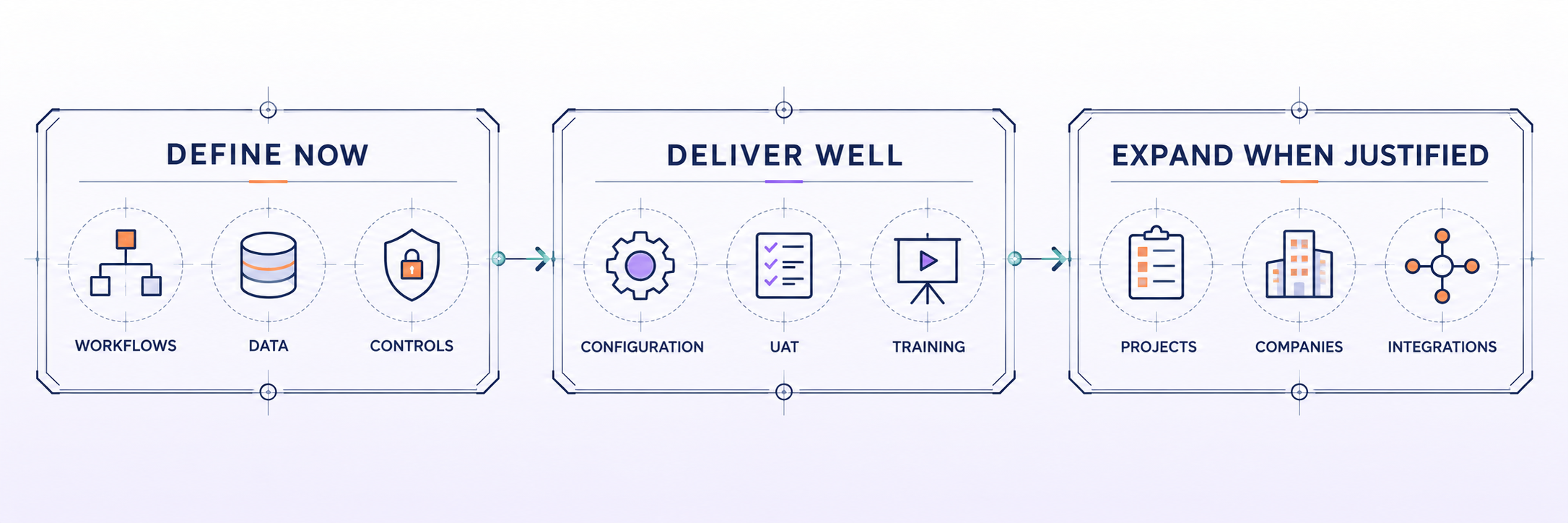
How should the scope separate now, later, and optional work?
Each requirement should receive one of three decisions, with a reason and dependency—not a vague promise to “add it later.”
Required at launch
Include the records and steps needed to complete the agreed outcome safely. If the first outcome is governed real estate sales and collection, unit availability, customer identity, contract terms, payment obligations, receipts, allocation, and accounting may be inseparable. Removing one can force teams back into spreadsheets and duplicate truth.
Deferred with protected dependencies
A later phase is credible only when the initial design records what it will need. Future projects may depend on reusable project and unit structures. Future companies may require entity-aware accounts, access, document sequences, and intercompany rules. Future integrations may depend on stable identifiers and ownership. Deferring the user interface is different from ignoring the data and architectural dependency.
Optional unless the operating model requires it
Construction is a clear example. A developer managing its own execution may need procurement, inventory, project costs, subcontracting, and progress visibility. A sales-led developer may gain full value from connected commercial, financial, service, and handover workflows without taking on construction scope. Human Resources, marketing integrations, advanced service channels, and additional legal companies should follow the same evidence-based decision.
The boundary between customer engagement and operational authority also matters. A CRM may manage early relationship activity while ERP governs unit commitments, contracts, installments, and accounting. The guide to CRM versus ERP for real estate developers explains how to make that boundary explicit without losing customer context.
What Tesla, Madkour, and Modon demonstrate about scope
Three Archer Solutions projects illustrate different answers to the same scope question. They are operating situations—not product tiers or packages.
Tesla Developments: proportionate scope without unnecessary complexity
Tesla Developments moved from Excel to Odoo for 20 users. The confirmed coverage includes Real Estate, Sales, Accounting, Projects, Inventory, and Purchase without unnecessary module complexity. The evidence is not that 20-user projects are universally simple. It is that a broad operational need can be designed proportionately when the required workflows and boundaries are understood.
Madkour Developments: a controlled starting point that expanded
Madkour Developments is a large company that began by launching the EOI workflow for its first real estate project in ten days. It then expanded into the full real estate scope, later Human Resources, and current Purchase and Inventory work. The ten-day result applies only to the initial EOI workflow; its value here is proof that an initial outcome can launch quickly when its boundary is clear and later adoption is handled as separately governed scope.
Modon Developments: complexity where the operating model justifies it
Modon Developments required a wider customized environment for 200 users across five companies and eight projects. The implementation connects real estate and NPV operations, CRM and sales, broker commissions, accounting, Customer Experience, lead integrations, intercompany workflows, and six years of historical data. This is evidence that Archer can handle demanding scope—not an argument that every developer needs Modon’s architecture.
Scope principle: Tesla, Madkour, and Modon differ in users, companies, projects, history, sequence, and operational breadth. The common discipline is to design around the work and its dependencies, then deliver that boundary with the controls needed to trust it.
How should buyers evaluate a real estate ERP scope proposal?
A credible proposal should let management trace every cost and activity back to an operating decision. Before approving the scope, ask the provider to show:
- Outcome: Which complete business outcomes will work at launch, and what is explicitly excluded?
- Process boundary: Where does each included workflow start and end, including approvals, exceptions, cancellations, and reversals?
- Data responsibility: What data is prepared, migrated, validated, or left outside, and who accepts the result?
- Control model: How do roles, legal companies, approvals, auditability, and sensitive documents affect the design?
- Delivery work: Which analysis, configuration, customization, integration, testing, training, and go-live activities are included?
- Deferred scope: What can follow later, what dependencies must be protected now, and what new work may still be required?
- Acceptance: Which scenarios, reports, reconciliations, and owner approvals prove readiness?
Warning signs include a proposal based mainly on company size or user count; a module list without end-to-end workflows; “standard” used to avoid confirmed gaps; migration described only as file upload; construction treated as mandatory for every developer; later phases promised without dependencies; or a low first-phase figure achieved by excluding testing, training, access control, or launch support.
For companies operating in Egypt, Saudi Arabia, or across the Middle East, geography may change legal entities, currencies, tax and accounting treatment, contract routes, cheque practices, document controls, hosting or integration requirements, and user responsibilities. Those requirements should be verified during analysis rather than copied from another country or client. Geography changes the configured rules; it does not remove the need for one governed customer, unit, contract, payment, and accounting history.
Use the 10-point real estate ERP partner evaluation matrix to assess the provider behind the proposal as well as the scope itself. The right partner should be able to recommend a proportionate first release, explain every retained safeguard, and demonstrate the ability to handle more complex growth when the operating model requires it.
A right-sized real estate ERP implementation scope is therefore neither the shortest list nor the broadest one. It is the clearest defensible boundary between what must work now, what can follow later, and what should remain optional. If your organization is deciding that boundary, discuss your real estate ERP project with Archer Solutions.