

Real estate ERP implementation cost is not determined by a price list alone. Two developers with similar user counts may require very different levels of work because their companies, projects, contracts, payment histories, integrations, approvals, and acceptance standards are different. A credible estimate begins with an agreed operating scope and exposes the assumptions behind every material workstream.
Real estate ERP implementation cost is not determined by a price list alone. Two developers with similar user counts may require very different levels of work because their companies, projects, contracts, payment histories, integrations, approvals, and acceptance standards are different. A credible estimate begins with an agreed operating scope and exposes the assumptions behind every material workstream.
Why generic ERP package prices mislead real estate buyers
A package can be useful as a commercial starting point, but it cannot define the true implementation effort until the buyer and provider agree what the system must control.
Real estate operations preserve long relationships between projects, units, customers, reservations, contracts, amendments, installment plans, collections, accounting, service activity, and handover. If a proposal says “CRM, Sales, and Accounting” without explaining these relationships, the apparent price may exclude the work that makes the environment operational.
User count matters for licensing, training, access, and coordination. It is not a reliable substitute for complexity. A 40-user organization with difficult historical data, unusual approval rules, and several integrations may demand more implementation work than a larger company using a focused and well-prepared scope.
Odoo publishes its subscription inclusions and exclusions on the official Odoo pricing page. That is useful for understanding platform licensing, but Odoo also separates implementation services, analysis, data import, customization, training, and custom-code maintenance from the subscription. A credible real estate ERP implementation cost comparison therefore treats the software subscription and the implementation work as related but distinct decisions.
The same principle applies to company size. A growing developer may begin with one project and a proportionate first release, while preserving the data model and controls needed for expansion. Right-sizing should remove unjustified scope, not the foundations that prevent a later rebuild. The detailed guide to right-sizing a real estate ERP implementation explains that decision separately.
The eight drivers of real estate ERP implementation cost
| Cost driver | What the buyer must define | Why it changes effort |
|---|---|---|
| Company and project structure | Legal entities, projects, shared services, intercompany activity, and reporting levels | More structures require additional rules, access design, accounting treatment, validation, and reporting. |
| Lifecycle scope | Which stages run from lead and unit availability through contracts, collections, service, and handover | Each included stage adds records, responsibilities, handoffs, exception paths, and acceptance scenarios. |
| Data condition and history | Source systems, record volumes, relationships, quality, reconciliation, and required history | Clean opening data is different from reconstructing years of contracts, schedules, payments, and accounting links. |
| Integrations | External sources, direction, frequency, identity matching, failure handling, and ownership | An integration is a governed operating dependency, not only a technical connector. |
| Configuration and justified development | What standard configuration supports and which approved gaps need extension | Development adds design, code, security, testing, documentation, and future maintenance obligations. |
| Roles and governance | Permissions, approvals, segregation, exceptions, and audit requirements | Stronger controls require policy decisions, access matrices, scenario tests, and evidence. |
| Reporting and accounting acceptance | Posting rules, reconciliations, statements, management reports, and approval owners | Finance and operational reports must be proved against accepted transactions, not merely displayed. |
| Rollout and acceptance model | Phases, pilot scope, UAT, training, cutover, stabilization, and support boundaries | Sequence affects coordination and cash flow, but phased delivery does not automatically reduce total work. |
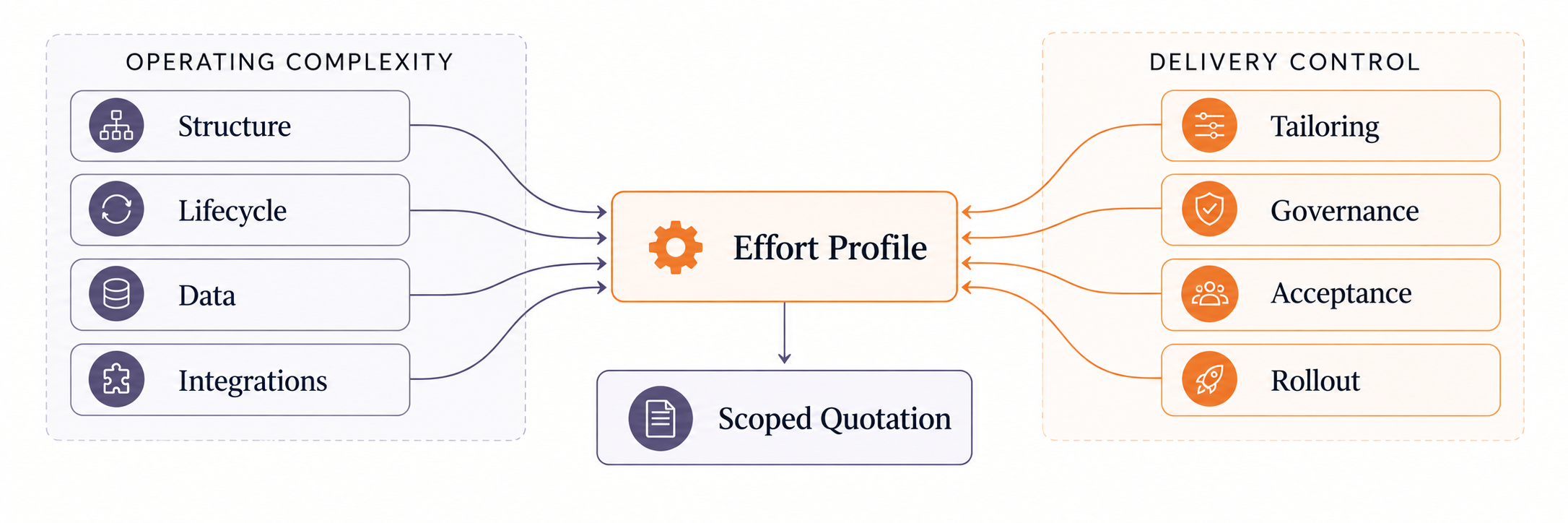
1. Company and project structure
The first question is not “How many users?” It is “What operating structure must the system preserve?” One company with several projects has different needs from a group with multiple legal entities, shared teams, different shareholders, and intercompany transactions.
The design must define which records belong to each company, which users may cross company boundaries, how common master data is governed, and which reports consolidate information without erasing legal separation. These decisions affect configuration, accounting, access, testing, and training.
2. Lifecycle scope and optional operating areas
The common real estate chain usually connects units, customers, reservations, contracts, installment obligations, collections, accounting, service, and handover. Construction, procurement, inventory, project costing, HR, and other areas are conditional. They belong in the scope when the developer’s operating model and decision needs require them—not because every real estate ERP must include them.
The canonical Real Estate ERP pillar shows how this core and optional scope fit together. A quotation should state which stages are operational at launch, which are deferred, and which dependencies must still be protected.
3. Historical data and reconciliation
Historical data is a major real estate ERP implementation cost driver because relationships and acceptance matter more than row count alone. A customer name can be easy to load. A customer account linked to a unit, contract version, installment schedule, cheques, receipts, allocations, accounting moves, and service history is a reconstruction problem.
The source condition determines whether the route is controlled templates, direct database extraction, API-led transfer, or a combined method. Trial loads, exception handling, balance reconciliation, and business sign-off are part of implementation. The real estate ERP data migration guide explains those controls in depth.
4. Integrations and external dependencies
Every integration needs a clear owner, data contract, identity rule, failure path, retry behavior, monitoring method, and acceptance test. “Connect WhatsApp,” “import leads,” or “link the attendance device” is not enough to estimate the work.
Buyers should also distinguish a one-time migration from a continuing integration. A one-time transfer can be reconciled and closed. A live connection must continue handling duplicates, changed fields, outages, permissions, and support responsibilities after go-live.
5. Configuration, customization, and future maintenance
Configuration should be used where the platform can support the required policy without code. Development is justified when a material operating gap remains and the buyer can define its purpose and acceptance criteria.
The quotation should identify each extension, the requirement it satisfies, how it will be tested, and who owns its maintenance. Vague customization allowances hide risk in both directions: they can inflate the price without clarity or understate work that later appears as change requests.
What the published delivery evidence demonstrates
The purpose of case evidence is not to create a universal rate card. It is to show how different requirements change the work.
Centrada Developments connected 130 users across real estate sales, NPV, brokers, accounting, Customer Experience, handover, HR, WhatsApp, and attendance integration without adding construction to the confirmed core. It demonstrates why a connected functional scope should be assessed on its own operating boundaries.
Modon Developments required control across five companies, eight projects, 200 users, intercompany accounting, lead integrations, and six years of history. The case illustrates how organizational structure, data, integrations, and governance combine into implementation effort.
Reach Real Estate combined 175 users across eight country operations with strict SOPs, configurable country rules, commissions, refunds, security, and an integration-led transfer of approximately 200,000 leads. It shows why rule variability and system boundaries must be estimated explicitly.
These are evidence examples, not promises that another project will have the same cost, duration, or scope.
How to compare quotations without choosing the wrong baseline
Ask every provider to price the same decision model. At minimum, the proposal should answer:
- Which companies, projects, lifecycle stages, and modules are included?
- What is configured, what is developed, and what is explicitly excluded?
- Which data will be loaded, migrated, reconstructed, and reconciled?
- Which integrations are one-time and which remain live after go-live?
- Which roles, approvals, exceptions, and audit requirements are included?
- Which reports and accounting scenarios form part of acceptance?
- Who provides data, decisions, testing, training attendance, and sign-off?
- What is the change-control method when an assumption proves wrong?
- What stabilization and ongoing support are included or separate?
- What later phases are merely possible, and what would require a new estimate?
Warning signs include a single figure with no assumptions, a user-count multiplier used as the whole method, unlimited customization language, migration described only as file upload, and a schedule that omits business acceptance.
A credible cost estimate is an operating agreement
A credible real estate ERP implementation cost estimate is not the cheapest-looking number. It is the one that makes scope, assumptions, responsibilities, exclusions, acceptance, and change control visible before the contract is signed.
Archer’s Odoo pricing and implementation-cost guide explains the general pricing context. If your organization needs a real-estate-specific estimate, discuss your ERP project against the actual company structure, lifecycle, data, integrations, and governance requirements.