

Select a real estate ERP implementation partner by requiring relevant evidence across ten areas: architecture, industry understanding, execution depth, scalability, team focus, product evolution, lifecycle coverage, governance, post-go-live support, and HR/financial alignment. Score what each bidder can document, assign named owners and acceptance conditions, and convert the result into the implementation contract.
A real estate ERP buying decision can fail even when the selected software is capable. The greater risk is often choosing an implementation partner that understands the product but cannot translate property structures, contracts, installments, commissions, accounting, customer service, and handover into one controlled operating environment.
A polished demonstration does not prove that a partner can govern scope, migrate history, coordinate departments, manage change, support go-live, or keep the platform usable as the business grows. Buyers therefore need a repeatable way to compare delivery evidence—not a collection of claims that cannot be tested.
This guide complements Archer Solutions’ broader Real Estate ERP approach for property developers and its overview of working with an Odoo ERP implementation partner. It focuses specifically on the selection decision.
What should you evaluate in a real estate ERP implementation partner?
Direct answer: Evaluate the partner across ten selection elements: system architecture and integration, real estate industry understanding, proof and execution depth, scalability, team structure, product evolution, lifecycle coverage, project governance, post-go-live support, and HR/financial alignment. For each element, require relevant evidence, identify warning signs, and convert the accepted answer into a named contract output.
The ten elements fall into four decision areas:
- Operating fit: Can the proposed system reflect the company’s actual legal, property, customer, commercial, service, and financial structure?
- Delivery fit: Is there a credible team and governed method for turning scope into an accepted operating system?
- Continuity: Will the platform continue to evolve and receive informed support after go-live?
- Evidence and growth: Has the partner delivered comparable complexity, and can the design support the buyer’s expected scale?
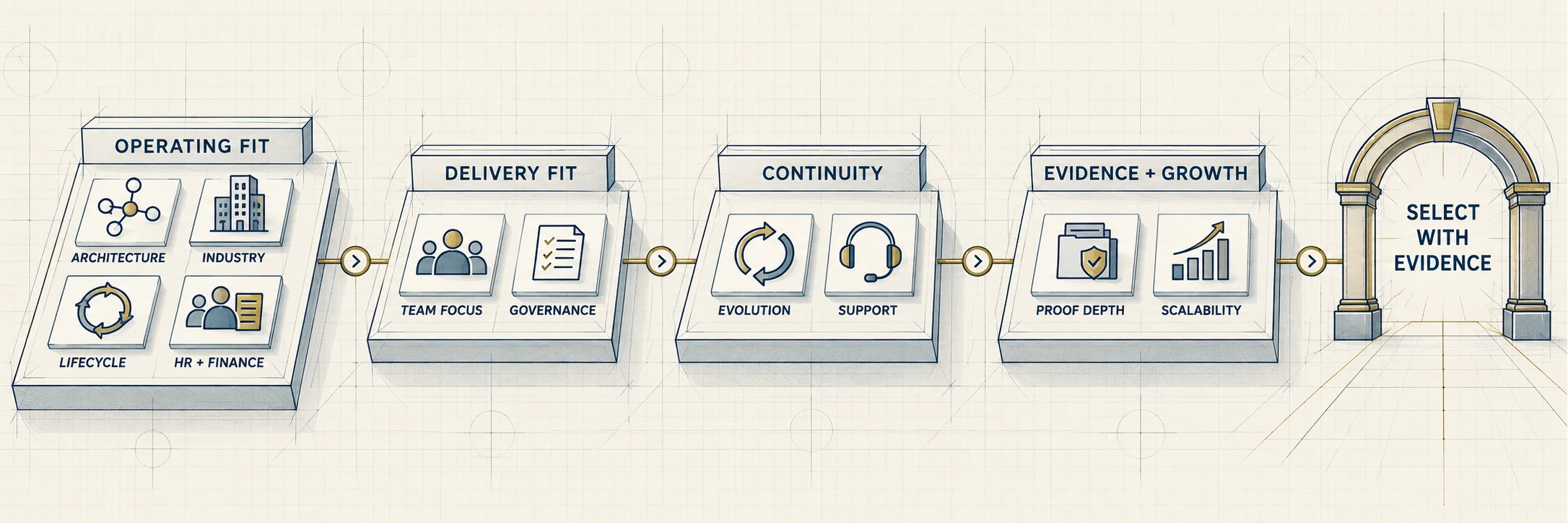
The 10-point real estate ERP partner evaluation matrix
Use the matrix during initial qualification, demonstrations, reference checks, proposal comparison, and contract negotiation. The purpose is not to reward the longest proposal. It is to expose where evidence, ownership, boundaries, or acceptance conditions are missing.
| Selection element | Evidence to request | Warning sign | Required output |
|---|---|---|---|
| 1. Architecture and integration | Target architecture, system boundaries, integration methods, master-data ownership, hosting assumptions, and security responsibilities. | A product demonstration with no explanation of how systems, companies, data, and integrations will be governed. | Approved solution architecture, integration register, data owners, environments, and operational boundaries. |
| 2. Real estate understanding | Scenario-based walkthroughs for projects, units, reservations, contracts, installments, collections, brokers, accounting, After Sales, and Handover where applicable. | A generic CRM or accounting demo that treats a property sale as a standard invoice. | Approved process model, requirements catalogue, exception list, and explicit scope exclusions. |
| 3. Proof and execution depth | Comparable cases, relevant references, accepted migration or testing evidence, and examples of decisions made under real delivery constraints. | One vague success story, references from unrelated operating models, or results that cannot be traced to delivered scope. | Evidence register, approved reference checks, proof-of-fit scenarios, and acceptance evidence expected during delivery. |
| 4. Scalability and growth | Experience with relevant user, company, project, transaction, and country complexity; plus assumptions for future volume, entities, integrations, and reporting. | A one-size design that is either too limited for growth or too complicated for the current organization. | Documented capacity assumptions, growth scenarios, performance controls, and expansion roadmap. |
| 5. Team structure and focus | Named functional, technical, data, project, training, and support roles; relevant industry experience; availability; and continuity arrangements. | An impressive sales team followed by an unnamed delivery pool or dependence on one individual. | Named team, responsibility matrix, allocation assumptions, substitution rules, and decision rights. |
| 6. Product evolution and updates | Upgrade approach, customization controls, release management, ownership of technical debt, and a process for evaluating business changes. | Every update is treated as a separate emergency change request, with no roadmap or upgrade responsibility. | Configuration/customization principles, release process, upgrade responsibilities, and evolution roadmap. |
| 7. Lifecycle coverage | A boundary map showing what is covered from lead and unit availability through contract, collection, accounting, service, and handover—and what remains in another system. | “End-to-end” language with no distinction between common commercial scope and optional construction or project-cost operations. | Lifecycle scope matrix, interface points, ownership at handoffs, and agreed exclusions. |
| 8. Project governance | Delivery plan, governance cadence, decision log, risk and issue controls, change process, testing, training, cutover, and acceptance method. | Informal tracking, unclear client responsibilities, or a go-live date unsupported by testing and acceptance gates. | Baseline plan, governance calendar, escalation path, change control, acceptance plan, and named approvers. |
| 9. Post-go-live support | Hypercare plan, severity definitions, response and resolution targets, escalation, monitoring, knowledge transfer, and release ownership. | Support begins after delivery with a different team that has no access to implementation knowledge. | Support schedule, service levels, transition pack, knowledge ownership, and continuous-improvement process. |
| 10. HR and financial alignment | Company and chart-of-account design, analytic structure, approval responsibilities, workforce data boundaries, and reporting ownership. | Commercial, finance, and workforce data are designed separately with no shared ownership or reporting model. | Approved finance and HR boundaries, control matrix, reporting dimensions, reconciliations, and data owners. |
How should the evidence be scored?
A simple four-level scale keeps the evaluation understandable across procurement, operations, finance, and technology:
- 0 — No evidence: the bidder has not addressed the element.
- 1 — Assertion: the response is a promise, generic slide, or standard product demonstration.
- 2 — Relevant documented evidence: the bidder provides a comparable case, method, example, or deliverable that can be examined.
- 3 — Contractable evidence: the documented response includes a named owner, project output, acceptance condition, and responsibility boundary.
The total provides a comparison point, not an automatic winner. A partner may score well overall while failing a critical condition such as data integrity, accounting control, security, or team availability. Buyers should therefore define mandatory gates alongside the score.
Selection principle: A strong answer becomes more valuable when it can be converted into a deliverable, owner, acceptance test, and contractual boundary.
Why operating fit must come before software features
Operating fit combines architecture, industry understanding, lifecycle coverage, and HR/financial alignment. Together, these elements determine whether the proposed ERP can represent the business as it actually operates.
A real estate developer may manage several legal companies, projects, phases, buildings, units, payment-plan structures, brokerage arrangements, and customer-service responsibilities. A partner should explain which records form the source of truth, how transactions cross company boundaries, which processes are common, and where project-specific differences are allowed.
The scope must also distinguish the common commercial-to-customer lifecycle from conditional activities. Sales-led real estate implementations commonly include units, reservations, contracts, installments, collections, brokers, accounting, statements, After Sales, and Handover. Construction execution, procurement, subcontracting, and project costing belong only when the developer’s confirmed operating model requires them.
Feature lists cannot resolve this. Require scenario demonstrations based on the buyer’s process, followed by an approved scope and architecture. That creates a testable baseline for delivery.
What proves that the delivery team can execute?
Delivery fit depends on the people assigned and the governance used. Ask who will lead discovery, functional design, development, data, accounting validation, testing, training, cutover, and support. Confirm their availability and what happens if a named person changes.
Then examine how the partner manages decisions. A credible method should show how requirements are approved, risks and changes are recorded, client responsibilities are tracked, test evidence is closed, users are trained, and go-live is accepted. Governance should not be an administrative layer added after problems appear; it is how the project preserves scope, accountability, and evidence throughout delivery.
A practical proposal therefore includes more than a timeline. It contains a responsibility matrix, delivery outputs, decision cadence, escalation path, testing model, acceptance gates, and assumptions that could change cost or schedule.
How do product evolution and support protect the investment?
Go-live is the beginning of operational use, not the end of implementation responsibility. New projects, payment plans, teams, companies, reports, integrations, and regulatory requirements will expose design decisions that were not visible during the initial rollout.
The buyer should understand who owns configuration, custom development, technical debt, release management, upgrades, support knowledge, and improvement requests. A support agreement is stronger when the supporting team understands why the system was designed in a particular way and can distinguish an incident from a scope change or an improvement.
Ask the bidder to connect its upgrade approach with its customization principles. The aim is not to avoid every customization; it is to ensure that each extension has a justified business purpose, controlled ownership, documentation, testing, and an upgrade path. For Odoo projects, compare the proposed roadmap with Odoo’s official standard and extended support policy, then record the applicable version, timing, and responsibilities in the contract.
Why repeatable evidence matters more than one impressive reference
One reference can show that a partner participated in a project. It does not by itself prove that the team can repeat the result under a different source condition, organizational scale, deployment model, or country structure.
Look for evidence across several types of complexity: system recovery, migration, multi-company accounting, multinational rules, public-sector governance, user scale, long-lived customer history, and post-go-live evolution. The evidence does not need to match the buyer exactly. It should demonstrate that the partner recognizes comparable risks and can explain the controls used to manage them.
Scale should also be interpreted carefully. A large user count is useful, but the harder question is whether the design can accommodate more entities, projects, transactions, rules, integrations, and reporting dimensions without losing control. Require assumptions and future scenarios rather than accepting “scalable” as an undefined promise.
What should an Egyptian real estate company verify?
An Egyptian buyer should add local verification to the same ten-point matrix. This does not mean selecting a partner only because it has a local address. It means confirming that the proposed team can operate within the organization’s language, financial, regulatory, procurement, hosting, support, and escalation realities.
- Current delivery standing: verify the bidder’s legal identity, proposed local delivery team, project-relevant certifications, and current references directly during due diligence. Record the verification date and supporting evidence rather than relying on directory position or a permanent marketing count.
- Relevant Egyptian evidence: ask for references involving comparable property, installment, accounting, multi-company, public-sector, or data-migration conditions—not merely an Egyptian company name.
- Arabic and English delivery: confirm the languages available for workshops, documentation, training, support, and user-facing outputs.
- Financial and regulatory readiness: require the partner to identify the current official requirements that affect the confirmed scope and how responsibility will be divided among the client, partner, auditors, tax advisers, and other authorities.
- Deployment and data boundaries: agree hosting, access, security, backup, environment, integration, and data-residency responsibilities where they apply.
- Support and escalation: verify working hours, local escalation, on-site expectations, remote coverage, and how urgent issues reach people who understand the implementation.
Independent directories may help a buyer discover candidates, but they do not replace official partner verification, relevant references, delivery-team review, or contractable evidence.
What does relevant delivery evidence look like?
The following published Archer Solutions cases demonstrate different selection elements. They are evidence from specific scopes, not guarantees that every project will have the same duration, modules, volumes, or results.
New Jersey Developments: proof under an extreme recovery condition
New Jersey Developments required recovery from a non-operational Odoo 14 environment using incomplete code and the final database dump. Archer reconstructed the business relationships required for customers, units, contracts, installments, payments, cheques, accounting, brokers, After Sales, Handover, and Customer Experience before converting the approved history into Odoo 18.
The published case documents four companies, six projects, 1,710 units, 39,015 installments, and 49,606 payments. Independent validation closed with 282 passes, no warnings, and no blockers. This is an extreme case rather than a normal implementation baseline; its selection value is the visible emphasis on semantic reconstruction, financial integrity, staged validation, and accepted evidence.
Review the New Jersey Developments ERP recovery case.
Reach Real Estate: configurable multinational operations
Reach entered the program with strict SOPs and an internally developed platform. Its Odoo 18 environment supports 175 users across eight country operations while preserving different accounting, security, visibility, commission, refund, and workflow requirements.
The historical-data route was not a conventional spreadsheet upload. Archer used a purpose-designed script and APIs to transfer approximately 200,000 leads from Reach’s marketing platform and migrate units, contracts, payments, and wider operational history. The case supports architecture, configurability, integration, scale, and evidence that established procedures can be translated rather than discarded.
Explore Reach Real Estate’s configurable multinational ERP platform.
Modon Developments: multi-company scale and governed growth
Modon’s published implementation scope supports 200 users across five companies and eight projects. It connects real estate and NPV operations, CRM and sales, broker commissions, accounting, intercompany transactions, Helpdesk, Customer Experience, lead integrations, and six years of operational history.
For a buying committee, the important signal is not the prestige of the client’s developments. It is the partner’s ability to define and govern intercompany accounting, departmental adoption, historical continuity, integrations, and expansion across a substantial operating structure. Those are relevant tests for buyers whose own procurement process demands evidence of control at scale.
See how Modon connected five companies and eight projects.
El Nasr Housing & Development: public-sector governance and continuity
El Nasr is an Egyptian public-sector real estate and urban development company affiliated with the Holding Company for Construction and Development under the Ministry of Public Business Sector. Its program replaced local software, spreadsheets, and paper processes with a governed on-premise Odoo environment for 150 users.
The scope connected real estate, finance, projects, procurement, assets, legal operations, HR, and investor services while reconstructing approximately 40 years of history that could not be exported reliably. This case is relevant when buyers need evidence of documentation, auditability, formal governance, broad workflow control, historical continuity, and delivery in a public-sector operating environment.
Read the El Nasr public-sector ERP transformation case.
What should be settled before the implementation contract is signed?
Before commercial approval, the buyer should be able to answer these questions from the final proposal and its attachments:
- Which business processes and legal entities are included, excluded, or dependent on another system?
- Which assumptions could change price, schedule, architecture, or required client effort?
- Who are the named delivery and client owners, and what decisions can each role approve?
- Which integrations, data sources, migration boundaries, and environments are included?
- How will design, configuration, customization, testing, training, and cutover be accepted?
- What evidence must exist before each phase and before go-live?
- How are risks, issues, changes, delays, and disputed requirements governed?
- What happens during hypercare, support, future releases, and upgrades?
- Which service levels and escalation paths apply after go-live?
- Which critical requirements are mandatory gates rather than weighted preferences?
Warning signs: Be cautious when a proposal depends on a generic demonstration, leaves the delivery team unnamed, describes every process as standard, treats migration as a row-count exercise, uses “end-to-end” without boundaries, or schedules go-live without documented acceptance conditions.
Select the evidence before selecting the partner
The strongest ERP partner proposal is not necessarily the longest or the least expensive. It is the one that gives the buying committee enough relevant evidence to understand the operating design, delivery method, team, responsibilities, risks, acceptance conditions, support model, and path for future change.
Use the ten elements as a shared evaluation language across procurement, operations, finance, technology, and executive sponsors. Score the evidence, preserve mandatory gates, and carry the accepted outputs into the contract. If historical data is a major part of the selection risk, use the related guide to evaluate a real estate ERP data migration plan.
To compare additional implementation conditions, browse Archer Solutions’ published ERP case studies. If your organization is defining its selection criteria, evidence requirements, or implementation scope, discuss your real estate ERP project with Archer Solutions.