

Real estate broker commission management should govern the complete indirect-sales chain: identify the commercial referrer, route the opportunity fairly, preserve attribution, freeze the approved deal context, resolve the applicable policy, require release evidence, control exceptions and blocks, and reconcile the payable result with accounting. A broker name and percentage field cannot provide that control.
Real estate broker commission management should govern the complete indirect-sales chain: identify the commercial referrer, route the opportunity fairly, preserve attribution, freeze the approved deal context, resolve the applicable policy, require release evidence, control exceptions and blocks, and reconcile the payable result with accounting. A broker name and percentage field cannot provide that control.
That distinction matters because broker-led sales are no longer a side channel for many developers and brokerage operators. The opportunity may cross CRM, inventory, reservation, contract, collection, commission, payable, and payment processes while different companies, projects, customer markets, and commercial agreements apply. Archer’s Real Estate ERP model for property developers and brokerage operations places these relationships inside the wider customer, unit, contract, financial, and service lifecycle.
What must real estate broker commission management control?
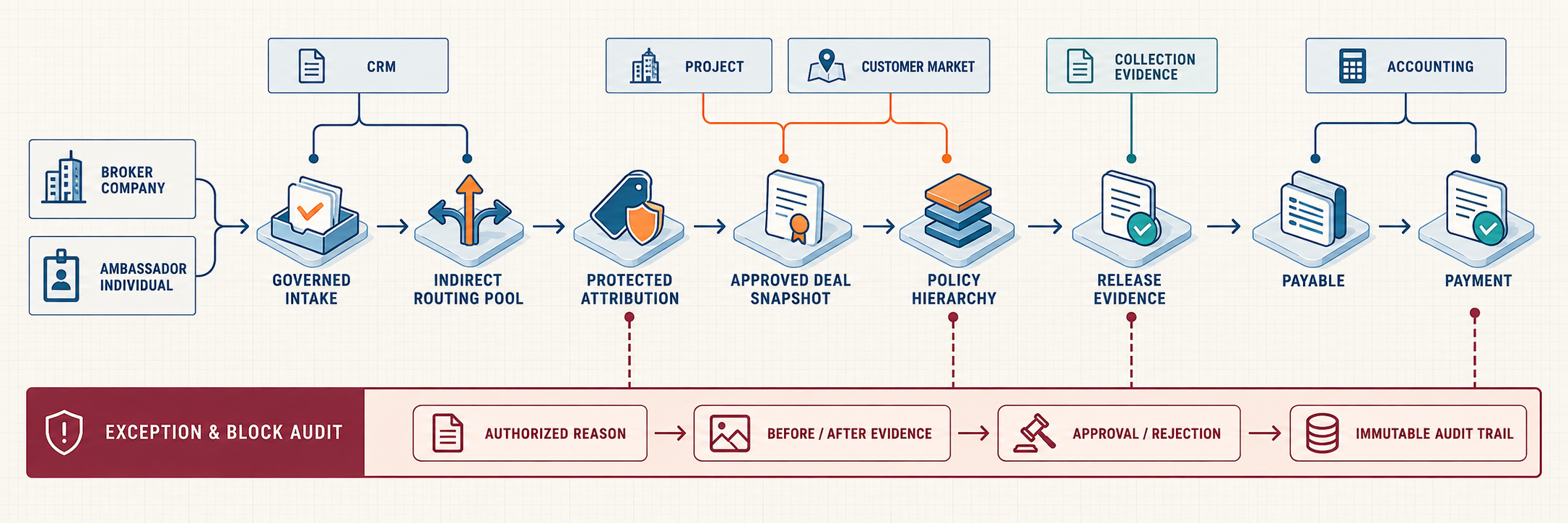
A dependable design makes eight connected controls visible and testable:
- Governed intake: identify whether the source is direct, a broker company, or an individual ambassador, and retain the originating evidence.
- Channel-aware routing: assign the sales work through the correct eligibility and fairness pool without letting indirect activity distort direct-lead allocation.
- Protected attribution: preserve the commercial referrer even when the opportunity owner, team, project, or customer record changes.
- Approved deal snapshot: freeze the company, project, unit, customer market, referrer, commissionable basis, and policy version that govern the sale.
- Policy resolution: apply the authorized company, project, market, class, broker, ambassador, and deal-exception precedence.
- Release evidence: distinguish calculated entitlement from the collection or business event that makes an amount eligible for settlement.
- Payable and payment control: prepare, approve, account for, and settle the result without duplicate or unexplained payment.
- Exception and block audit: retain actor, authority, reason, before-and-after values, decision, evidence, time, and affected record.
These controls cross application boundaries. Archer’s Odoo platform approach connects CRM, Sales, contracts, collections, Accounting, and governed records so that the referral does not disappear when an opportunity becomes a reservation or contract.
Why must direct and broker leads use separate routing fairness?
Direct and indirect demand may share the same hard eligibility conditions—for example, company, project, team, language, market, product knowledge, availability, and permitted salesperson. They may even use the same assignment method. They should not share one fairness counter when the business wants the two channels managed independently.
Consider compensated Round Robin. An ordinary indirect opportunity can move to the next eligible salesperson. A constrained opportunity may have to go to a named or specially qualified salesperson. That assignment still counts as service inside the indirect pool, so the salesperson can be skipped in later ordinary indirect passes until colleagues catch up. The direct pool remains unchanged. This prevents broker opportunities from making someone appear overloaded for direct demand, and direct activity from distorting broker allocation.
Commission percentage should not silently select the salesperson. Routing answers who is eligible and who should receive the work fairly. Commission policy answers who may earn which amount under the approved commercial agreement. Combining those decisions makes both harder to explain.
Odoo 19 supports multiple sales teams, assignment rules, and capacity controls. A real estate implementation must then define the channel, project, class, durability, retry, fairness, and audit behavior required by the operating model. The detailed Real Estate CRM vs ERP guide explains why lead activity begins in CRM while contract, collection, commission, payable, and accounting control extend into ERP.
Routing principle: direct and indirect opportunities may share eligibility logic without sharing the same service history. Fair allocation and commission resolution are related controls, not the same calculation.
How should the system distinguish brokers, ambassadors, classes, and attribution?
A Broker is a company or commercial organization. A named employee may submit or follow a lead, but the broker company remains the commercial referrer and the normal external payable party. An Ambassador is an individual acting in their own capacity. A referral from an existing customer can remain an ambassador occurrence rather than creating an overlapping third type.
Broker Classes provide another governed dimension. A company may maintain several active classes with different eligibility, project access, service rules, or commercial-policy roles. Each active broker belongs to the applicable active class; ambassadors do not inherit broker classes. Classification can narrow routing, but a later class change must not rewrite the basis of a completed deal.
Attribution therefore needs its own protected record. The system should retain the source channel, broker or ambassador identity, originating contact where relevant, recorded time, supporting evidence, and authorized replacement history. Reassigning the salesperson should not remove the referrer. Correcting the customer should not create commission on another deal. Blocking a broker later should not erase earlier opportunities.
The broader lead-to-handover Real Estate ERP workflow shows where governed intake sits inside the full property journey. Broker attribution begins near lead capture, but it must survive reservation, contract, collection, customer service, and eventual handover.
How should project, customer market, and commission precedence work?
The approved sale should freeze the commercial context needed to reproduce the decision later. At minimum, that snapshot normally includes legal company, project, property or unit, customer, customer market, referrer type and identity, broker class when applicable, commissionable basis, contract or reservation reference, approval state, and policy version.
Customer market should be an explicit sale-time classification—such as Local/Domestic or Overseas according to the organization’s governed terminology. It should not be guessed later from a changed address, nationality, telephone number, or current CRM value. A missing Overseas policy should not silently fall back to Local if the business did not approve that behavior.
The exact hierarchy is client-specific, but a controlled design can resolve external commission in this order:
| Precedence | Policy source | Control question |
|---|---|---|
| 1 — highest | Approved deal-specific exception | Was a bounded exception approved for this exact deal, receiver, basis, and rate outcome? |
| 2 | Individual broker project override | Does the approved agreement permit a named broker rule for this project and market? |
| 3 | Broker Class project policy or Project Ambassador policy | Which project rule applies to this referrer type, class, customer market, and deal date? |
| 4 — default | Company Broker Class or Company Ambassador default | Is there an authorized company-level default for the exact market and receiver type? |
Internal salesperson commission follows its own direct/indirect, market, role, project, and company logic. Changing an external broker rate should not silently change the routing class or internal beneficiary. Later configuration should govern new deals, while the frozen snapshot preserves how an existing approved sale was evaluated.
Why must entitlement, release, payable, and payment remain separate?
A commission can be calculated without being eligible for payment. The design should distinguish four states: the policy-derived entitlement, the event or cumulative threshold that releases some or all of it, the approved payable prepared for accounting, and the actual settlement. Collapsing them into commission due creates duplicate payments and makes partial releases difficult to reconcile.
Release may depend on cumulative customer collections, a contract or reservation event, receipt of commission from a developer in a brokerage model, or another approved evidence source. No one trigger is universal. The Real Estate ERP installment-management guide explains how contractual schedules, NPV-driven changes, collections, cheque allocation, penalties, discounts, reconciliation, accounting, and customer statements establish governed payment evidence.
Internal and external streams may also differ. They can use different beneficiaries, dates, release schedules, visibility, approvals, accounting routes, and settlement providers. The ERP must prevent the same evidence from releasing the same obligation twice and retain the connection among deal snapshot, policy result, evidence, payable document, payment, reversal, and remaining balance.
Tax, withholding, payroll, clawback, refund, and vendor-payment treatment depends on the organization’s contracts, accounting design, jurisdiction, and approved providers. A buyer should reject a demonstration that promises one universal automatic payment rule without first defining those dependencies.
How should commission exceptions and broker blocks preserve audit?
A deal-specific exception should require an authorized approver, a business reason, the expected record version, and immutable old and new values. It may change a permitted rate outcome for the named deal; it should not silently replace the referrer, customer market, commissionable base, collection evidence, or another deal. A rejected request remains evidence of the decision rather than disappearing from the history.
Blocking is a different control. Blocking a broker should stop new or refreshed referrals and new attribution according to policy. It should preserve earlier opportunities, deals, paid amounts, unpaid obligations, and the identity that explains them. The event needs actor, reason, time, version, scope, and authorization. Archiving a contact is not a substitute.
An unpaid settlement for a blocked broker may need a specific exception. That exception should be bounded to the exact payable or amount, single-use where applicable, authorized, and audited. It is not the same as unblocking the broker. Attribution replacement, block, unblock, rate exception, release exception, and payment exception should be distinguishable when management or an auditor reviews the chain.
In Archer’s current real-estate implementation work, broker and ambassador registration, company-scoped classes, separate direct and indirect routing pools, compensated Round Robin integration, protected attribution, broker blocking, and immutable audit evidence have been implemented and tested. Complete commission calculation and settlement remain dependent on the client’s approved contracting, collection, accounting, and payment design; they should not be sold as one universal configuration.
What do Modon, Reach, and El Nasr demonstrate?
The following projects support different parts of the decision. They do not imply identical contracts, rules, rates, or scope.
Modon Developments: sophisticated multi-project governance
Modon Developments provides evidence from a sophisticated developer environment connecting real estate operations with CRM, Sales, broker commissions, Finance, Customer Experience, Handover, and multi-company governance. The useful lesson is not a confidential rate or procurement claim. It is that broker control must remain explainable across companies, projects, commercial approvals, long customer-payment histories, and accounting records.
Reach Real Estate: owned projects and multinational brokerage
Reach Real Estate combines development activity with brokerage operations across eight countries in the approved public case. Its operating model includes configurable country rules, tiered commission structures, project and program differences, exceptions, refunds, owned inventory, brokered inventory, and release after receipt of developer commission in relevant arrangements. This shows why project, market, agreement, evidence, and settlement route must be explicit without exposing confidential percentages or thresholds.
El Nasr Housing & Development: an external-only project-sales channel
El Nasr Housing & Development provides a contrasting public-sector operating pattern. Stakeholder evidence confirms that sales are handled through an external brokerage company under exclusive whole-project arrangements rather than an internal sales team. The brokerage provider and contract terms remain confidential. The buyer lesson is that ERP cannot assume every developer has an internal sales organization; the commercial channel itself must be configurable and auditable.
How should buyers test a broker and ambassador design?
To test real estate broker commission management, ask the implementation team to demonstrate one indirect opportunity from intake through payment, then change the salesperson, customer market, project policy, collection evidence, and broker status. The design should answer these questions:
- Does the system preserve broker-company and ambassador-individual identity correctly?
- Can direct and indirect work use separate fairness counters without duplicate CRM pipelines?
- Can broker classes govern eligibility without hard-coding one permanent hierarchy?
- Does a salesperson reassignment preserve the commercial referrer?
- Is the approved deal snapshot sufficient to reproduce the policy decision later?
- Can rate precedence resolve by company, project, customer market, class, broker, ambassador, and approved deal exception?
- Are Local/Domestic and Overseas classifications explicit and frozen rather than inferred later?
- Can release use authorized collection or event evidence without creating duplicate payable amounts?
- Do exceptions preserve reason, authority, before-and-after values, version, and decision?
- Do blocks stop future work while preserving earlier attribution, obligations, payments, and audit?
- Can Finance reconcile policy result, released amount, payable, settlement, reversal, and remaining balance?
- Which parts are implemented controls and which still depend on approved accounting or settlement design?
Broker operations often span different customer markets, project agreements, external sales models, collection evidence, legal entities, and accounting or settlement rules. Those differences should be configured explicitly while the lead, referrer, customer, unit, deal, and payment retain one governed identity and audit trail.
Good real estate broker commission management is not the design that stores the most commission percentages. It is the one that can explain who brought the opportunity, why it was routed to a salesperson, which deal context and policy were approved, what evidence released the amount, who authorized an exception, whether a block applied, and how Accounting reached the final payment. If your organization is defining or testing that chain, discuss your real estate ERP project with Archer Solutions.